
For many years, marketing attribution has felt predictable predictable for those who ran ads across Meta platforms.
You ran ads. Someone clicked or purchased and a conversion would then appear in your ads dashboard. The performance of your ads looked measurable, explainable and controllable.
But alas that no longer exists in this post-privacy updates world.
Today, advertisers are making decisions using partial data, modelled reporting and fragmented customer journeys but many are still trying to apply old expectations to a completely different measurement reality…and this was us for a while here at Marketing Made Social
In the end, we decided to adapt because we realised that attribution hasn’t just become harder – it has fundamentally changed, and if we didn’t understand how to better determine a conversion – we’d get left behind, and our clients would too.
Why Attribution Used to Feel Reliable
Early digital advertising created an illusion of certainty in the platform. You could trust the data you saw with only a small percentage margin of error. Actions taken off your ad, such as a purchase on your website or shop, are attributed back to your ad if they happened within a certain number of days after someone viewed or clicked on your ad.
This is because most customer journeys happened on a single device, whether it was a mobile device or a laptop. Both were set up to be able to track user journeys from click to conversion using cookies – that reliable bit of Javascript that a website would deliver to your browser settings. Once installed, it would track every time you visited a particular website (or app). Cookies tracked behaviour consistently and platforms could follow users from click to purchase with relatively little interruption.
Last-click attribution became the default because it appeared logical:
- Someone clicked an ad
- They bought something
- The ad got credit
For simpler buying journeys, this worked well enough. Marketing teams grew used to dashboards that seemed definitive. Performance could be judged quickly, budgets adjusted confidently and results explained cleanly to stakeholders.
You could select the following:
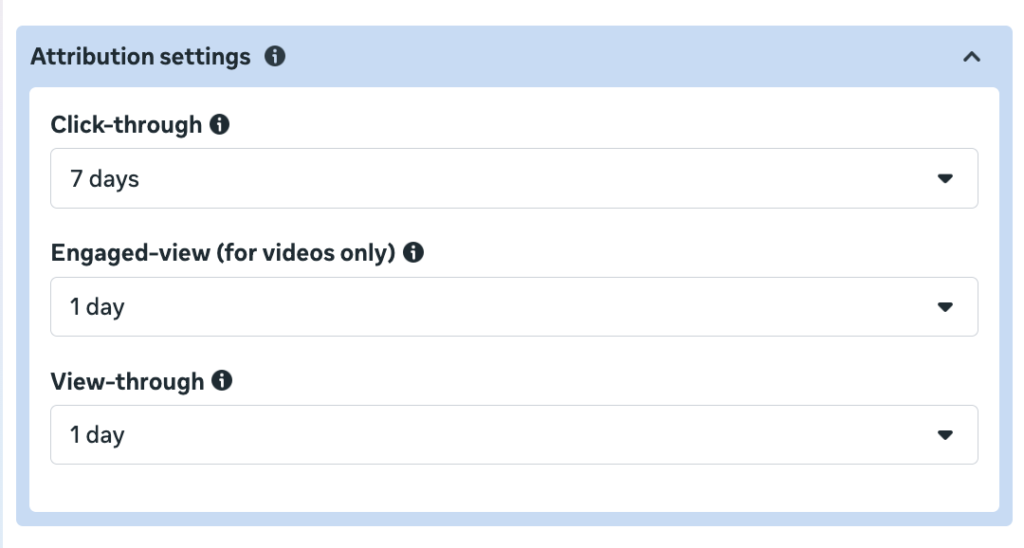
7-Day Click: The standard model which attributed 100% credit to the last ad click within a 7-day period.
1-Day View-Through: Credits conversions if a user saw, but did not click, an ad within 24 hours of converting.
28-Day Click/View (Legacy): Formerly common, these allowed for a longer, less accurate, and less privacy-compliant window for tracking user journeys.
Last Click/Touch: The fundamental logic for most old models, where the final ad interaction before a purchase receives all the credit.
But even then, attribution was never perfectly accurate. It was simply consistent enough that nobody questioned it.
It was the rise of the hyper-retargeting because advertiser knew they could count on the attribution reporting. We all fussed over the performance of some ads and discarded others because they didn’t “convert”.
We stressed when our channel didn’t “perform” and we watched advertisers abandon Meta ads because they didn’t see direct conversions. But savvy advertisers started to note that data wasn’t always accurate, and when they zoomed out, realised that just because the platform couldn’t count attribution, didn’t mean it wasn’t creating leads or sales from other channels.
In the background, many began to see inconsistencies with the data they were seeing, and safe “catch-alls” like Google Analytics not able to track a traffic source to back up the claims that ad platforms like Meta were making. When surveyed, Meta found that three-quarters of advertisers asked didn’t trust the data they were seeing so change was inevitable.
What Actually Broke Attribution
A combination of the rise of mobile use, the difficulties in tracking that use and the change in how users behaved online when converting all led to the old models being phased out. This isn’t surprising given the effect of Apple’s iOS privacy-related updates where apps are required to ask users if they want ot be tracked or not.
Privacy and tracking limitations
Browser restrictions, consent requirements and operating system updates reduced the ability to track users across sites and devices. Data that once flowed freely became fragmented because users chose to opt out of being tracked by cookies or tracked via their devices. A big $10 billion problem for Meta.
Multi-device behaviour
Customers now discover brands on one device, research on another and purchase somewhere else entirely. The linear journey attribution models depended on rarely exists anymore. You could see an ad on your mobile but they buy when you’re logged into your desktop computer. That old attribution model would count the mobile view, but this wouldn’t be accurate.
Platform modelling replacing tracking
Instead of observing every action directly, platforms increasingly rely on statistical modelling to estimate outcomes as there’s just too much data. Reporting hasn’t disappeared, but certainty has been replaced with probability. Data doesn’t arrive real-time anymore.
Longer and more complex buying journeys
Especially in higher-consideration industries, conversions often happen days or weeks after initial exposure. Attribution windows struggle to capture influence across time The result isn’t broken marketing performance. It’s broken visibility.
The Dangerous Reaction Most Brands Had
When attribution became less clear, many businesses responded by trying to regain certainty and added more tools, more dashboards and more tracking layers, but we are never getting back that source of truth as there are too many factors to take into consideration now.
How can you measure Meta ads attribution on iPhones, when 98% of users opted out of being tracked?
But we still see businesses and brands began optimising for what could be measured instead of what actually drove growth.
Common reactions include:
- Turning off campaigns too early because ROAS appears low
- Overvaluing bottom-of-funnel activity
- Ignoring creative influence that doesn’t receive direct credit
- Blaming platforms rather than reassessing measurement expectations
In trying to restore clarity, businesses often reduce performance without realising that users may have seen the ads on Meta first, before deciding to Google the brand name and then make the purchase. But in this example, it would be Google search that got the attribution. Or they may have seen the email offer you sent out Monday and then got reminded again of the offer on Friday when they saw an ad. Even though the ads created the sale, isn’t it the email that did the work?
Credit vs Contribution: The Shift That Matters
Realising that multiple channels can create the sale is the key to understand attribution ion the new world and good advertisers have made that switch.
Meta switched off its 28-day attribution and gave us new tools to improve the data too – like the Conversions API, which reads data direct from server-side in an anonymised way, rather than relying on the just the Pixel.
It still allows us to select Standard Attribution still with some limited settings:
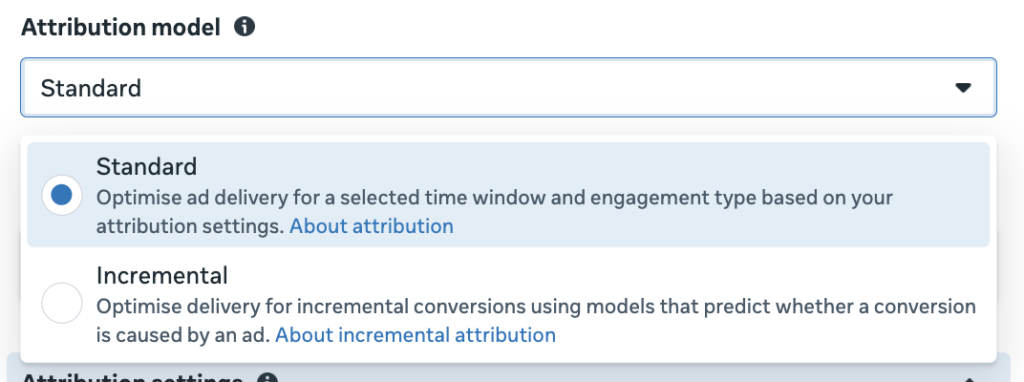
But advertisers can also use the new Incremental Attribution settings using Meta’s machine learning (accuracy still TBC).
This new phase forces advertisers to ask “what activities and campaigns contribute to growth” rather than drills down to a dingle ad or channel.
A campaign may not receive last-click credit but still increase branded search, improve conversion rates or shorten sales cycles. Its value exists even if attribution cannot assign it cleanly.
Growth rarely comes from one interaction. It emerges from accumulated influence that you can have online.
Understanding contribution allows marketers to evaluate performance realistically rather than defensively although we have challenged clients to switch off Meta ads to see what the effect would be on sales if they didn’t believe it worked as a channel. This also works!
How we Evaluate Performance Now
Instead of searching for perfect attribution, we look for patterns and activities across the full funnel. It forces us to triangulate data between Meta, website tracking like G4, and looking the actual sales or leads data. We also lift our heads up and look at external factors like time of year and social effects – which can both impact ad performance.
We typically look at ad data trends over a 7 day period, and rarely judge ads on daily results. This was we look at user behaviour across the week and then compare to other activities inside the business.
This is a vital skill to have as an advertiser in 2026 as working in a silo’d channel but still expecting to create sales performance is not going to work.
Eventually AI-driven modelling, aggregated reporting and predictive analytics will replace deterministic tracking. Platforms will estimate outcomes using patterns instead of direct observation.
This doesn’t mean marketers lose control. It means the role of marketing leadership changes.
Success increasingly depends on interpretation, not just reporting.
The ability to understand context, customer behaviour and business economics becomes more valuable than reading dashboards alone.
We’re no longer data collectors only used to the Meta ads platform – we have a 360 view of all channels with an ability to zoom out and looks at trends and behaviour.
If you’re struggling to understand how your own ads are converting, them let’s have a chat.
0 Comments