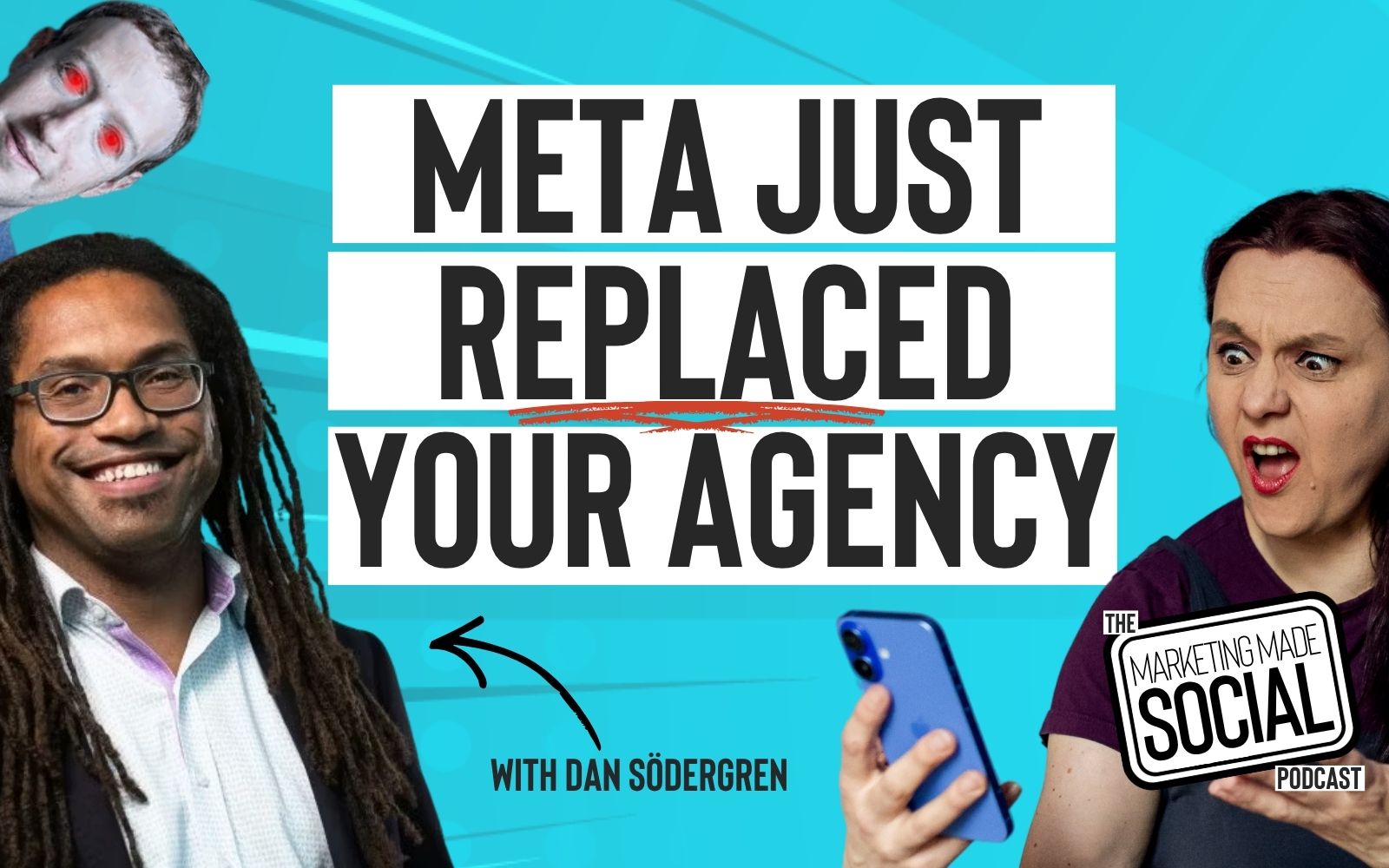
What if the marketing agency model as we know it already has an expiry date? And what if someone predicted it a decade ago, over a beer, with one of the most influential AI minds on the planet?
In this episode of the Marketing Made Social Podcast, Vicki sits down with Dan Sodergren, TEDx keynote speaker, BBC AI expert, and author of The Fifth Industrial Revolution, to ask a genuinely uncomfortable question. Now that Meta has acquired Manus AI, and Mark Zuckerberg is openly talking about a future where business owners simply connect their bank account and let Meta handle everything, what actually happens to agencies, media buyers, and the people who’ve built careers running ads?
Dan has been talking about the future of work and technology for over twenty years. He ran a digital marketing training agency back when people still took the rip out of him for using Google. He’s not a hype merchant. He’s practical, and he brings real positivity to a conversation that most people would rather avoid. This is one of those episodes that functions less as industry commentary and more as a strategic wake-up call.
What just happened with Manus AI
In early 2026, Meta acquired Manus AI for roughly $2 billion, significantly more than they ever paid for Instagram. Manus has been integrated into Ads Manager, and Zuckerberg’s stated vision is blunt: businesses will eventually come to Meta, state their objective, connect their bank account, and walk away. No creative needed. No targeting decisions. No campaign structure. Meta’s AI will handle the lot.
If you’re sitting in an agency or running ads for a living, that sentence should either excite you or terrify you. Probably both.
The platforms becoming the agencies was always going to happen
Dan’s first point is that none of this is new or surprising. It was predictable twenty years ago.
For the last two decades, agencies have existed in the gap between a platform and its users. SEO became a trillion dollar industry because Google never explained its algorithm. Paid social agencies exist because Meta’s ad platform is complex enough that small businesses need help navigating it. Media buyers, account executives, strategists, all of these roles sit inside an ecosystem owned by someone else.
The logic of that ecosystem was always temporary. Google could have said, at any point, “we’ll be the agency that gets you to the top of Google.” They didn’t, because it didn’t suit their business model. But there was never a moral or structural reason for agencies to exist. They existed because the platforms chose to let them.
Meta has now made a different choice. And that choice, as Dan frames it, isn’t about whether it’s good or bad. It’s about capitalism doing what capitalism does. The platforms are taking the land back.
The feudal model most agencies have been running on
Dan has a sharper metaphor for what agencies have actually been doing.
Agencies have been crofters on other people’s land. Farming someone else’s platform, making a living off someone else’s ecosystem, and then acting surprised when the king shows up with an army and asks for the land back.
It’s the same thing that happened with SEO. Websites that built entire businesses on Google traffic are now watching 90% of that traffic disappear into AI-generated search results. The outrage feels justified, but the underlying reality is that the traffic was never theirs. They were always renting.
If you’re an agency looking at Meta’s acquisition of Manus and feeling blindsided, the hard truth is that you were always renting the land.
The Demis Hassabis prediction
Ten years ago, Dan sat down for a beer with Demis Hassabis, the founder of DeepMind, now head of Google’s AI. Demis had already sold DeepMind to Google but wasn’t yet the internationally recognised figure he is now. And he told Dan, plainly, that marketing agencies as we knew them had roughly ten years left.
We’re roughly at the end of that ten year window. And Dan’s own view is that the actual timeline is shorter than that.
“The AI doubles in capability every seven months,” he says, referencing the way machine learning is outpacing even Moore’s Law. Meta didn’t buy Manus for it to stay at its current capability level. They bought it because they know how quickly it will improve, and they know what that improvement is worth.
What AI can and can’t do yet
This is where Dan’s framing gets genuinely useful, because it’s not a blanket “AI will replace everyone” argument.
AI agents are extremely good at the mechanics. Crunching numbers, executing campaigns, managing bids, optimising targeting, running the grunt work of paid media. These are exactly the jobs that currently employ junior buyers, account executives, and media planners in agencies.
Those jobs are at serious risk. Not in ten years. In two to five.
What AI isn’t good at, at least not yet, is creating meaning. The human side of marketing, the craft, the judgement, the taste, the ability to read a cultural moment and know what to say, that’s still human territory. In The Fifth Industrial Revolution, Dan talks about four intelligences: artificial intelligence, organisational intelligence, independent intelligence, and emotional intelligence. Only one of those is AI. The other three are where humans still win.
The agencies that survive will be the ones that concentrate their people around that work, not around the work AI will absorb.
The soft skills become the hard skills
One of the most striking moments in the conversation is Dan’s flip on the soft skills conversation.
For years, “soft skills” has been the dismissive term for emotional intelligence, collaboration, sales, relationship building, and the human side of work. The implication was always that these mattered less than technical skills.
Dan’s argument is the opposite. In a world where AI handles the technical execution, the soft skills become the sharpest skills. The ability to sell, to build community, to create emotional resonance, to read a room, to understand people. These are the things that don’t scale automatically, and they’re the things that businesses will pay real money for in a world where everything else is commoditised.
If you’re an agency person wondering what to invest in over the next two years, it’s not learning Meta’s next tool. It’s deepening the human capabilities AI can’t replicate.
The plane analogy
One of the clearest points in the conversation is Dan’s plane analogy.
If you got on a plane and the announcement said “there is no pilot today, it’s all being done by computers,” you’d get off. Almost everyone would. And yet, technically, most planes are largely self-flying already. What makes us feel safe is the human at the front, in control, able to respond to something the automation missed.
That’s the future of agencies. The AI does the flying. The human’s job is the judgement call, the emotional read, the response to something unexpected. Agencies won’t disappear, but they’ll be much smaller, and the people in them will be doing very different work.
As Dan puts it: “What agencies really need to do is provide someone with amazing taste and amazing judgement, who’s really creative, who’s on the zeitgeist of the time, who can help create meaning. But you might not need twenty of them. And you certainly don’t need twenty ad buyers and media people and number crunchers, because that’s what the machine does.”
Why this is mostly a leadership failure
One of the bluntest moments in the conversation is Dan’s assessment of where agencies have actually failed. It’s not that AI came along and surprised anyone. It’s that agency leaders didn’t invest in their own technology when they should have.
Agencies are technology businesses. Or at least, they should be. And yet most of them have spent the last five years pouring money into lovely offices, nice culture, and Friday afternoon drinks fridges, rather than building proprietary data sets, training proprietary AI, and investing in the tech stack that would make them genuinely defensible.
“You should have had a small language model yourself anyway in your agency. Every agency should have their own AI agent. The fact they don’t is insane,” Dan says.
The agencies that were ahead of the curve built their own tools. The ones that weren’t are now watching Meta and OpenAI absorb the work they used to charge for.
What the future of marketing actually looks like
Dan’s vision of where marketing goes is both scary and genuinely exciting.
Frictionless marketing. AI agents will buy things for consumers before the consumer has to decide. Your phone knows what you need, orders it, schedules it, and handles the transaction. Most brands disappear from the buying conversation entirely because they’re no longer in the customer’s head.
Hyper-personalisation. Instead of running one ad to ten thousand people, you run ten thousand ads to one person, contextualised by time, location, mood, biometric data, and behaviour. This is already technically possible. It’s just waiting for platforms to fully deploy it.
The survival of premium brands. The brands that invest in community, real-life events, emotional resonance, and direct relationships with customers will continue to matter. A Louis Vuitton bag isn’t competing with “a bag.” It’s competing on identity. Those brands survive. The commoditised ones, the shower gels and supermarket staples, get absorbed into frictionless buying. The AI agent picks them based on price, ingredients, or user preference, not brand loyalty.
The end of mass advertising. Most of the advertising spend of the last century has been about persuading people they need things. When AI agents do the choosing, most of that persuasion becomes irrelevant. Which is why Meta is racing to become the layer that sits between your AI agent and the product itself.
What agencies should actually do now
Dan’s practical advice for agencies in 2026 is clear.
Go back to old-fashioned marketing. Community building. Real-life events. Gorilla marketing. Emotional intelligence. Founder-led storytelling. The stuff that isn’t being absorbed by AI, because it requires humans to do it.
Stop renting the land. Build your own data. Run your own email lists. Create your own content platforms. Anything that sits inside someone else’s ecosystem (Meta, Google, LinkedIn) is rented, and it can be taken back.
Invest in emotional intelligence as a core capability. The soft skills are the hard skills now. Sales, networking, community, taste, judgement. These are where value lives.
Get smaller, better, more specialised. You don’t need twenty media buyers. You need three people with taste, judgement, and the ability to create meaning, plus a tech stack that handles the rest.
Take advantage of the two year window. There’s a window right now where operators who understand Meta’s tools better than most can still command real value. That window is closing. Use it while it’s open, but don’t pretend it’ll be open forever.
The real takeaway
This isn’t a doom episode. It’s a reality check.
Marketing isn’t dying. The specific form of marketing agency that grew up in the last fifteen years is. And the people who adapt, who lean into the human craft, who build their own tools, and who stop renting land from tech platforms, are the ones who’ll still be here in five years.
If you’re in an agency and you haven’t had this conversation with your leadership team yet, now’s the time.
About Dan Sodergren
Dan Sodergren is a TEDx keynote speaker, BBC AI expert, and author of The Fifth Industrial Revolution. He’s also co-author of The Leadership Guide to the Times of AI, which he’s offering free to anyone who mentions they heard him on this podcast. You can find him on LinkedIn, where he regularly breaks down what’s happening in AI, the future of work, and how leaders should be thinking about both.
Want a second pair of eyes on your own business in light of all this?
If this conversation has made you reassess how your agency or in-house team is set up for what’s coming, our Ad Audit and Strategic Test Plan is a good starting point. A 1:1 expert review of your Meta ad account, your current setup, and where you’re positioned relative to the changes happening in the platform. Contact us to find more.